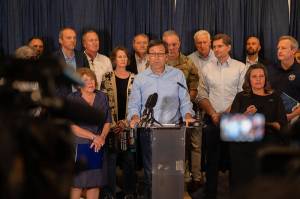
How the state Legislature spent 91 days in Olympia
Published 10:23 am Wednesday, April 18, 2012
Little more than 24 hours after the Legislature passed the supplement budget in the early morning hours of April 11, Rep. Pat Sullivan, D-Covington, visiting the Covington Chamber of Commerce to offer some insight on this year’s session.
Sullivan, who apologized if he appeared to be slightly groggy thanks to the long hours put in as the Legislature worked to pass the supplemental budget, talked about the 91-day session.
“This has been kind of an interesting week,” Sullivan told the chamber members. “Tuesday morning we worked through the day and through the night. The most important thing we had to accomplish was re-balancing our budget.”
In the fall, Sullivan said, there was a $2.2 billion gap in the state budget but by February a number of factors allowed forecasters to adjust the shortfall to about $1.1 billion.
“Things improved a little bit,” he said. “So, that made our job a little bit easier.”
Sullivan, who serves as the House Majority Leader, explained that in his first six years — from 2004 to 2010 — in the Washington state House of Representatives the number of bills introduced and passed each session was “unbelievable.”
Things have changed this year.
“Because of the budget, far fewer bills were introduced and passed,” Sullivan said.
With the supplemental budget passed, Sullivan said, he was pleased to see that a balanced operating budget as well as capital budget of which the focus was a jobs package was passed that also had no cuts to education and protected safety net programs for vulnerable citizens.
“For the budget, our proposal was to have no cuts to K-12 education, no cuts to higher education, no cuts to vulnerable populations… and I think we were able to accomplish those things,” he said.
It wasn’t easy, though, Sullivan said. In order to balance the budget “there were cuts, cuts to programs and those cuts will impact communities. They were real cuts. Just ask Green River Community College. Just ask the University of Washington.”
During the course of the regular and special sessions there was talk, Sullivan said, of developing a four-year balanced budget.
“There were a number of concerns,” he said. “It’s very difficult to project one year down the road, let alone two, four or six years. In the end we did negotiate where we did put in a four-year requirement… but what we passed built in some flexibility (for changing forecasts).”
An issue Sullivan is particularly passionate about is education and he worked on a bill, HB 2799, which created a five-year pilot project known as the Collaborative Schools for Innovation and Success.
The project partnered struggling schools with teacher preparation programs around the state to create new opportunities for students in those buildings.
This bill is intended to encourage colleges and school districts to collaborate in developing research-based models of teaching that are known to close the opportunity gap and help students learn better while also testing new methods of teaching training. It authorizes a maximum of six college-school district partnership to compete for grant funds of which three will receive money.
“It’s a program I’m excited about for those struggling schools as well as for those incoming teachers,” Sullivan said.
Other issues that were focused on during the session were state employee benefits as well as teacher health care plans.
Sullivan said it was important to try and find ways to cut costs while still providing state employee benefits.
“Washington state has one of the three best funded pension systems in the country,” he said.
On the topic of health care plans for teachers, Sullivan said, it required a different approach because so much is handled at the local level by individual school districts.
“There was some belief a statewide program was the way to go,” he said. “Trying to provide some kind of parity for family coverage was of concern for a number of members of the legislature.”
In addition, Sullivan said in response to a question about funding for local transportation projects, representatives from the 47th district were able to bring in funding for projects in Covington.
City officials requested funding to pay for repairs to the Covington Aquatic Center as well as a pair of transportation projects in Covington.
“That’s what we’ve done for the last 91 days,” Sullivan said. “We worked really hard right up until (the end of the session).”
Chamber members asked about what the Legislature can do in overseeing costs and fees of state colleges and universities as well as what the governmental body did to deal with the rising costs of health care for small businesses.
Sullivan explained that higher education institutions have a fair amount of autonomy but must assess fees within certain parameters.
A decade ago, he said, about 70 percent was covered by the state and the rest by students, but now it’s a 50-50 split. Rising costs as a result of cuts made by the state have been passed on to students and their families which leads to the number of students, for example, the University of Washington can accept.
This also leads to cuts in programs that would provide employees to growing companies such as Google, Sullivan said, so “over the next decade we have to make significant investments” in higher education programs which will train students for those kinds of jobs.
And, at this point, Sullivan said it is hard for the state Legislature to tackle health care beyond what is provided for state employees, teachers and vulnerable populations.
“Healthcare is very complex,” he said. “And a lot of it is tied to federal health care reform. But, we’ve really got to wait until the federal ruling in June.”
After 91 days of regular and special sessions there are still some things left for 2013.