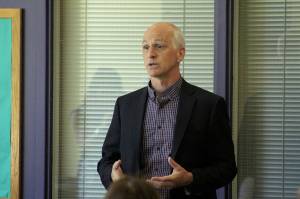
Pflug answers Reporter questionnaire
Published 9:54 am Thursday, October 30, 2008
The general election Nov. 4 will decide the race for state senator in the 5th District between incumbent Cheryl Pflug, a Republican who has held the office for four years, and Phyllis Huster, a Democrat. To help inform voters about the candidates, Pflug and Huster were offered a questionnaire from the Reporter about their campaigns and positions on issues. Only Pflug responded.
The district includes Maple Valley, Sammamish, Issaquah and Snoqualmie.
In the primary election in August, Pflug received the most votes – 17,116 (58.5 percent) – and automatically advanced to the general election against Huster (12,114, 41.4 percent), the only other primary candidate. The district has approximately 91,000 registered voters.
Reporter: In terms of your background and what you would do in office, what are the major differences between you and your opponent?
Pflug: I spent my lifetime here working, raising a family, volunteering in the schools and the community, and enjoying the natural beauty that draws and keeps us here. My life experience is typical of the people I represent, which gives me a deep understanding of our values and priorities. I publish my home phone number, work hard and vote independently – meaning I vote for the needs of my district, not my party.
Ten years in the Legislature has allowed me to develop the relationships, strategic skills, knowledge base and seniority to be effective. My innovation, expertise and passion for healthcare reform will be a critical component of the budget debate, as health expenditures threaten to overwhelm the budget.
I don’t support expansion of government or government-run healthcare. Because integrity matters, I never run smear campaigns, distort the truth about my opponent or make promises I can’t keep to get elected.
Reporter: During this campaign, what is the single biggest issue voters have wanted to discuss with you?
Pflug: The economy and taxes. People understand that the disconnect between state spending and state regulations hurts our economy and threatens jobs, as well as setting the stage for tax increases at a time when families and small businesses cannot afford to pay more.
Reporter: What can be done at the state and district levels to improve people’s confidence in their economic futures?
Pflug: The 2009 budget must to balance without tax increases and fund priorities like schools and transportation – road improvements, bigger park-and-rides and more buses. We must provide better service in more cost-effective ways.
Policy changes must be enacted to make job creation easier, like regulatory fairness, affordable power, lower employment costs for benefits, and eliminating taxes that make it hard to compete with neighboring states.
The burden of proof should be shifted from individuals to the government when there is disagreement on home valuations, the need for mitigation actions, etc. Government must prove it is right instead of making citizens prove government wrong.
Reporter: On a similar note, but more specific to businesses, how do you plan to help cultivate economic development in your district?
Pflug: We must increase transportation capacity to move people and goods without using congestion pricing, which amounts to a transportation system only the elite can afford to use. Building energy and transportation infrastructure also delivers affordable power and creates jobs.
Expanding companies need a trained workforce, which means supporting higher student achievement and providing more enrollment capacity in the demand fields of science, engineering, business, teaching and healthcare.
Repeal the estate tax, which hits family-owned businesses and farms the hardest.
Support B and O tax reform but oppose expansion of employment taxes or splitting tax rolls.
Provide infrastructure financing mechanisms and adequate municipal water for growing cities.
Reporter: If you aren’t elected, will you continue to play a role in public issues in some other way?
Pflug: I would probably seek an opportunity to advance better delivery and reimbursement models for high-quality healthcare and affordable insurance. However, I would be much more effective doing this from inside the Legislature.