
Every year, classrooms throughout King County learn about American history, and sometimes history has a local connection.
For the students at Mill Creek Middle School in the Kent School District, this includes learning about 1942’s Executive Order 9066, which led to the forced relocation and incarceration of over 125,000 Japanese-Americans and residents of Japanese descent following Japan’s attack on Pearl Harbor.
According to the Puyallup Valley Japanese-American Citizens League (JACL) website, a makeshift temporary concentration camp was set up at the Washington State Fairgrounds in Puyallup from April to September 1942, where over 7,500 people were imprisoned for simply being of Japanese descent, before being moved to more permanent concentration camps further inland.
At the beginning of November, local author and illustrator Kiku Hughes was joined by JACL president Eileen Yamada-Lamphere to talk to Mill Creek students about Hughes’ 2020 historical graphic novel “Displacement,” which was inspired by her grandmother’s own forced incarceration at Topaz in Utah. Thanks to a grant from the Rotary Club of Kent, Mill Creek students received copies of “Displacement.”
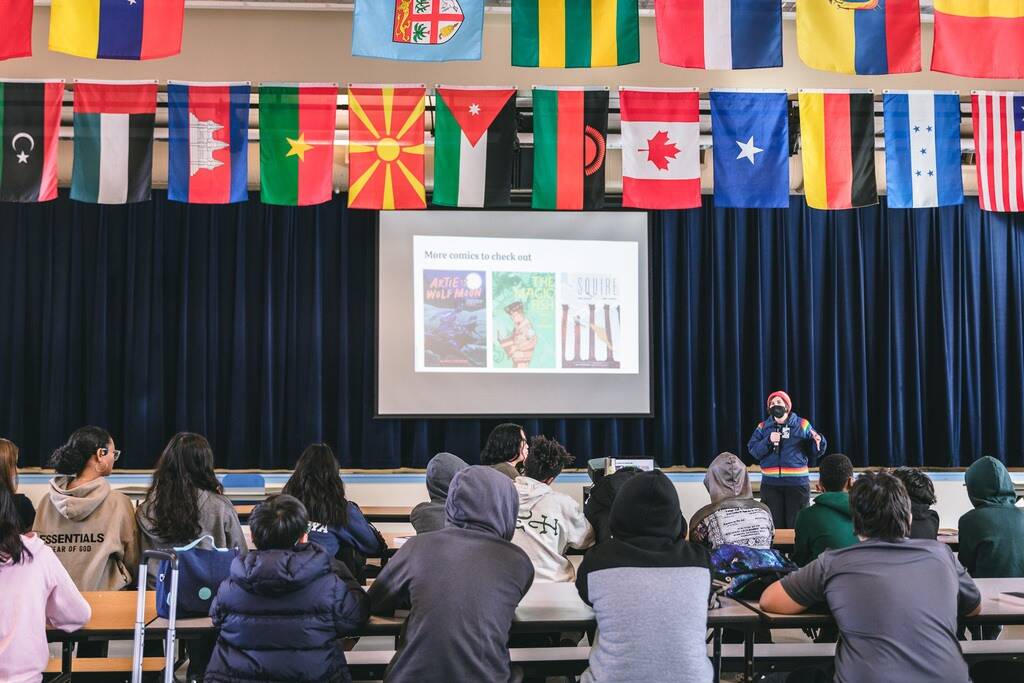
Kiku Hughes shares other local books and graphic novels about Japanese-American Incarceration and its dark history. Photo courtesy of the Kent School District.
“Kids in this region generally have a pretty good basic understanding of what happened because it happened mostly on the West Coast. It’s been a really incredible time to be able to share some of the lesser known stories and we’re really lucky in this region that we even get taught about Japanese-American incarceration at all,” said Hughes.
“I’ve heard since my book came out that people on the East Coast and the Midwest don’t usually get that kind of in-depth education about Japanese-American incarceration.”
Hughes has spoken to schools and libraries throughout Western Washington, saying that education on the camps for Washington students is tied to the region’s history.
“Historically, Japanese-Americans lived all throughout Bellevue [and] lived all throughout Kent as well, and the Puyallup River Valley. That whole region had a lot of farmlands that were operated by Japanese-Americans,” said Hughes.
Hughes’ grandmother had lived in San Francisco when she was sent to Utah with thousands of other Japanese-Americans.
“I actually never got to talk to her. Part of the premise of the book or, the inspiration, was the fact that she died pretty young and so she didn’t talk about the camp very much,” said Hughes. “In the 1980s, there was what was called the Redress Movement, which was where Japanese-Americans fought to have the government acknowledge what they had done during World War II, which was unethical and also unconstitutional.”
In 1988, the federal government officially apologized and paid reparations to those who had been detained and were still alive at the time.
“That was a huge moment in the community because a lot of people had been holding on to this sort of sense of shame about what they had gone through,” said Hughes. “Once Redress happened, once the government formally admitted that it had been wrong and it had been unjust, a lot of people were much more open to talking about their experiences.”
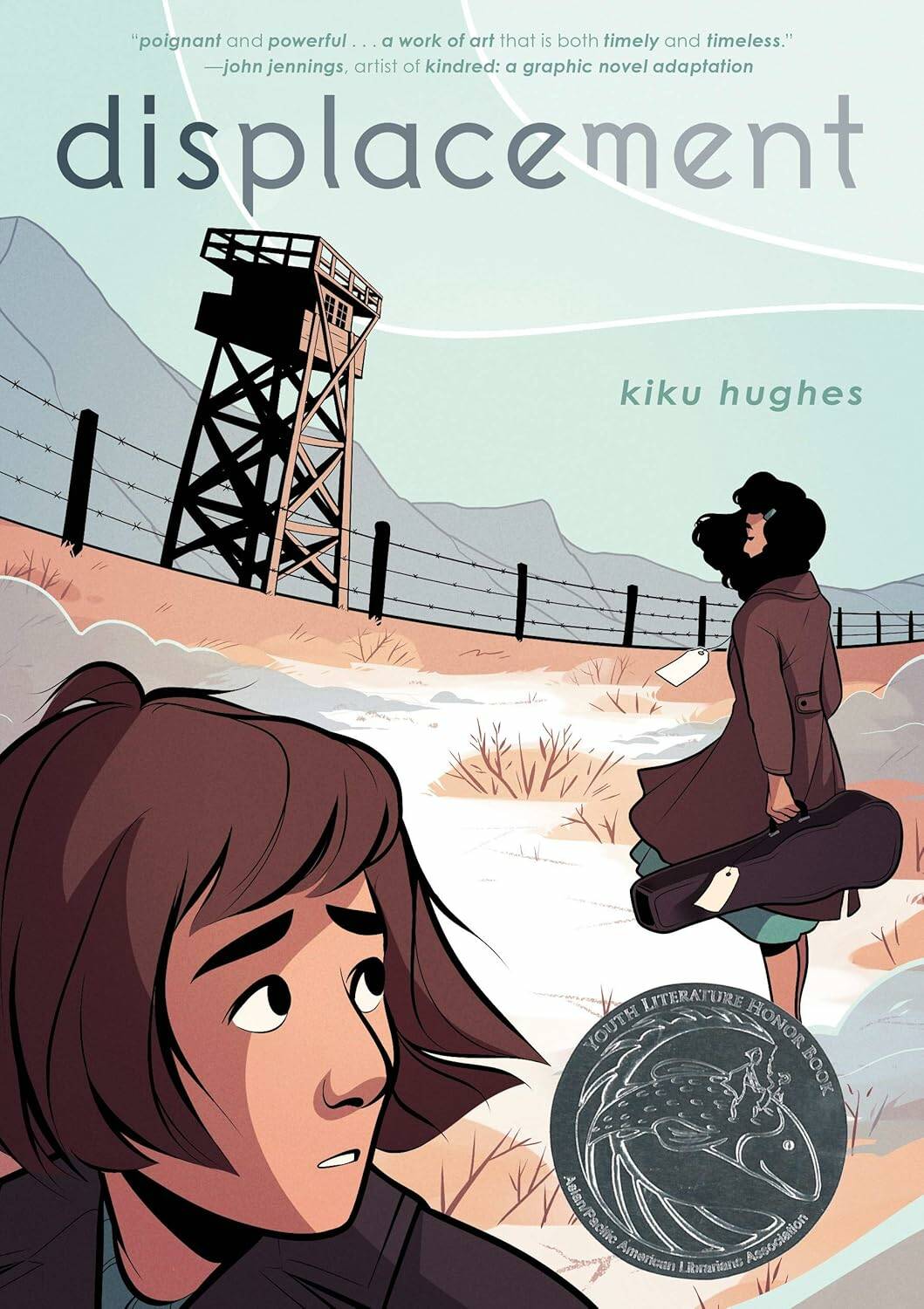
“Displacement” by Kiku Hughes. Image courtesy of Macmillan Publishers.
The legacy of the camps still live on. Hughes said she was also inspired to make “Displacement” by the 2016 presidential election and President Donald Trump’s first term.
“A lot of people in the Japanese-American community were seeing parallels between what happened to Japanese-Americans and the sort of rhetoric that was happening leading up to Pearl Harbor and what was happening at that time, especially with how Muslim-Americans were being treated and immigrants were being treated and almost any person of color,” said Hughes.
“Even now, in the second term, we see the Trump Administration is trying to use the Alien Enemies Act of 1789 to detain people without a warrant, without charges, and that’s the exact same Act that was used against first generation Japanese-Americans directly after Pearl Harbor.”